Repairing Your Current AC vs Replacing It Now: What the 2026 Refrigerant Shift Means for Rockwall County Homeowners
Every summer in Lavon, Rockwall, Royse City, Fate, and Heath, the same decision lands on homeowners at the worst possible time: the AC quits during a July heat wave, and now there is a choice to make between repairing the system that just failed or replacing it entirely. This year, that decision comes with a new layer most homeowners have not caught up on yet, a federal refrigerant change that quietly reshaped the math on repair versus replace.
The short version: the refrigerant that runs almost every AC system installed in the last fifteen years is being phased out. Your current system is not illegal, and nobody has to rip anything out tomorrow. But the change affects what repairs cost, what replacement options exist, and how the repair-or-replace decision should be weighed going forward.
Precision TX Heat and Air is a family-owned HVAC company based in Lavon serving Rockwall County and the surrounding DFW communities. This guide lays out what the 2026 refrigerant shift actually means for a homeowner facing an AC decision, without the scare tactics some of the industry is leaning on right now.
What Actually Changed With the Refrigerant Rules
For about two decades, nearly every residential AC system in Rockwall County ran on a refrigerant called R-410A. That is what is almost certainly in your system if it was installed after 2010. As of 2025, manufacturers can no longer build new residential AC equipment that uses it, and the industry has moved to lower-impact refrigerants.
This comes from the American Innovation and Manufacturing Act. According to the U.S. Environmental Protection Agency, the AIM Act was enacted in December 2020 and directs the EPA to phase down hydrofluorocarbons, the class of refrigerants that includes R-410A, because they are potent greenhouse gases. The EPA's Technology Transitions Rule set the sector restrictions that took effect for air conditioning and heat pump equipment.
Here is what the change does and does not mean for a homeowner:
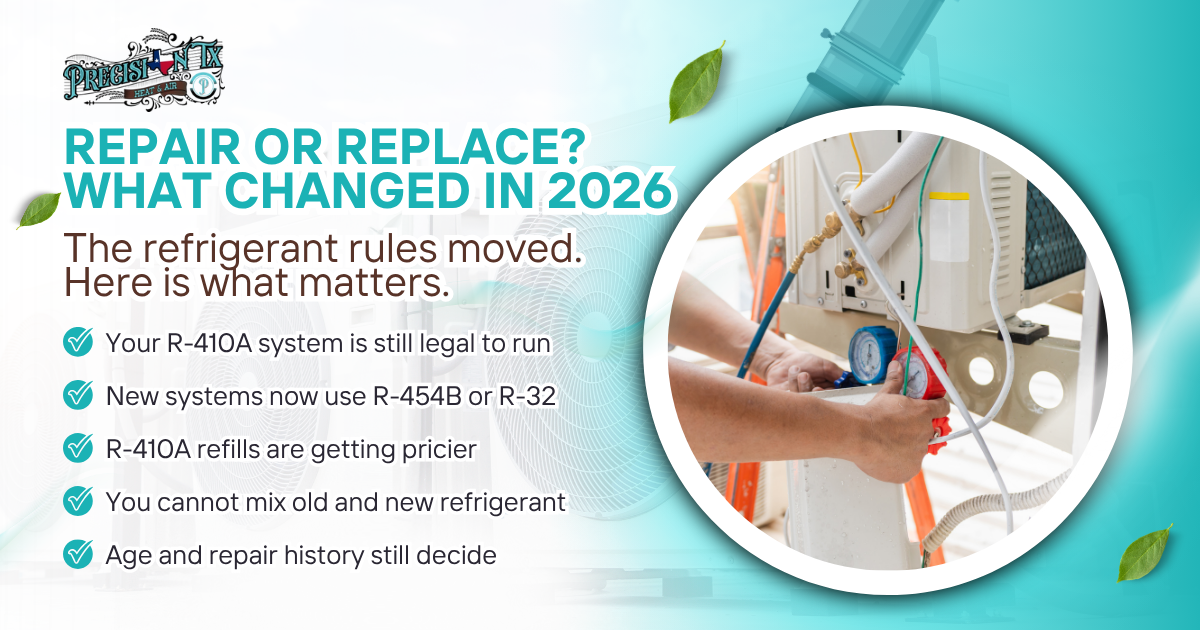
- Your current system is not illegal. You can keep running, servicing, and repairing an R-410A system for the foreseeable future.
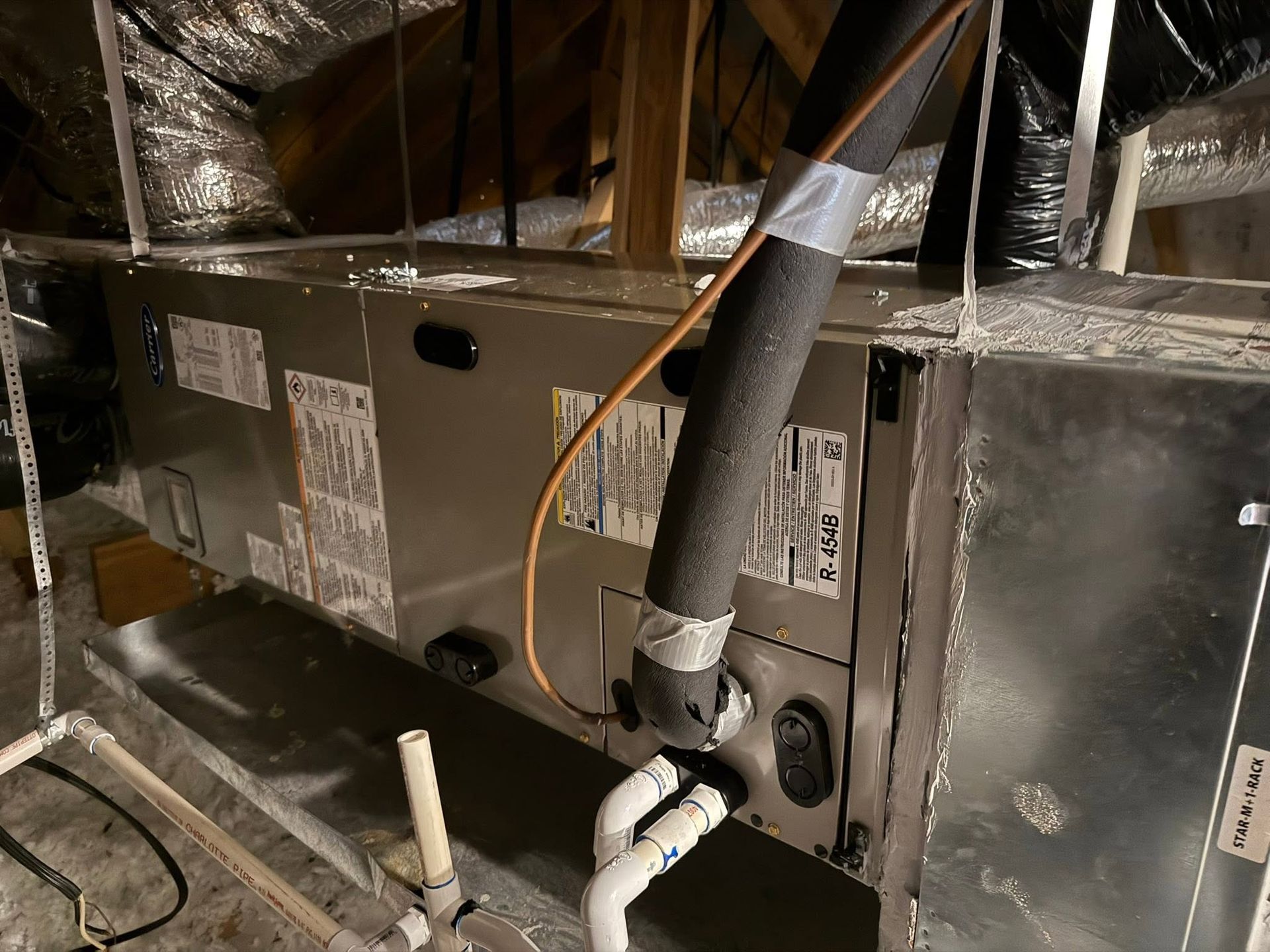
- New equipment uses new refrigerants. Systems built now use R-454B or R-32, both with far lower global warming potential than R-410A.
- You cannot retrofit. An R-410A system cannot be converted to run on the new refrigerants. They require different, purpose-built equipment.
- R-410A is getting more expensive. As production winds down, the refrigerant used to recharge existing systems is becoming scarcer and pricier.
That last point is the one that actually touches the repair-versus-replace decision, and it is worth understanding clearly.
Why the Refrigerant Change Affects the Repair Decision
The refrigerant shift does not force anyone to replace a working system. What it does is change the cost calculation on certain repairs, specifically any repair that involves recharging refrigerant.
According to the EPA's phasedown schedule, overall production and consumption of these refrigerants must drop significantly through the rest of the decade, with a major step-down in 2029 and an 85 percent reduction from baseline by 2036. As that supply tightens, the price of R-410A for servicing existing systems rises.
For a Rockwall County homeowner, this matters in specific repair situations:
- A refrigerant leak repair now carries a higher refrigerant cost than it did two years ago, and that cost trend continues upward
- A system that keeps losing refrigerant becomes progressively more expensive to keep topping off
- A compressor failure on an older R-410A system, which is one of the most expensive repairs, becomes harder to justify when the system already faces rising refrigerant costs
None of this changes the decision on a repair that does not involve refrigerant. A failed capacitor, a bad contactor, a blower motor, or a thermostat issue on an otherwise sound R-410A system is still a straightforward repair, and replacing the whole system over one of those would be the wrong call. The refrigerant change specifically weighs on repairs tied to the refrigerant itself and on aging systems that are approaching replacement anyway.
The Repair vs Replace Framework for a Rockwall County Home
The refrigerant change is one factor in the decision, not the whole decision. The honest framework weighs several things together.
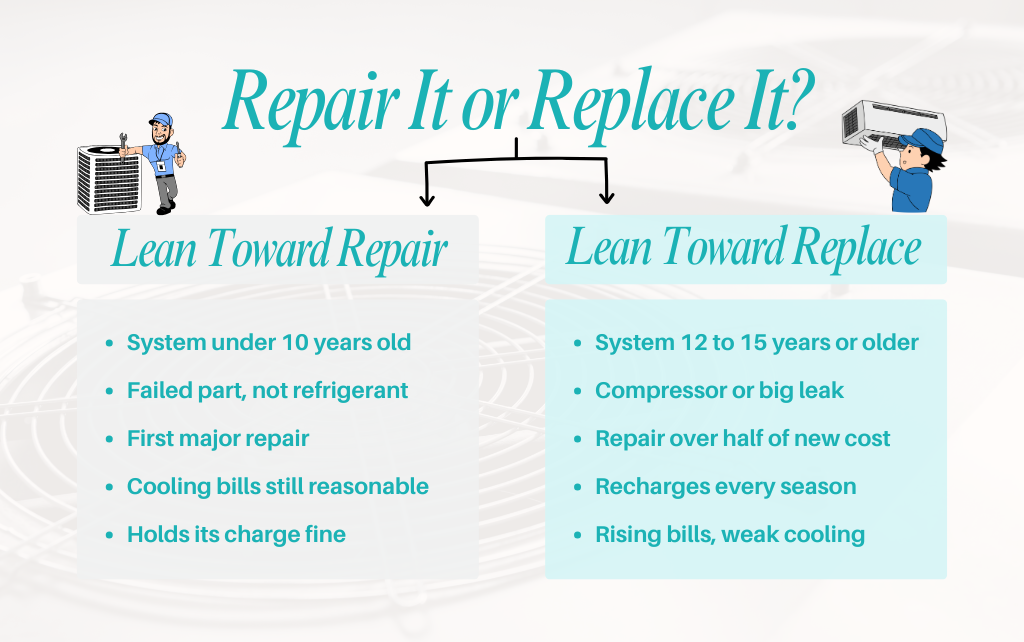
| Factor | Points toward repair | Points toward replacement |
|---|---|---|
| System age | Under 10 years | 12 to 15 years or older |
| Repair type | Non-refrigerant part | Compressor or major refrigerant leak |
| Repair cost | Under half of replacement | Over half of replacement |
| Refrigerant | Holds charge, no leaks | Recurring leaks, frequent recharges |
| Efficiency | Cooling bills reasonable | Rising bills, weak cooling |
| Repair history | First real repair | Third or fourth repair in a few years |
The general guideline HVAC professionals use is the repair cost threshold: when a single repair approaches or exceeds half the cost of a new system, replacement usually makes more financial sense, especially on an older unit. The refrigerant change shifts that threshold slightly for refrigerant-related repairs on aging systems, because those repairs now cost more and will keep costing more.
A practical way to think about it for a Lavon or Fate home:
- New system, non-refrigerant repair: almost always repair
- Old system, non-refrigerant repair: usually repair, but assess overall condition
- Old system, major refrigerant leak or compressor: replacement usually makes more sense
- Any age, recurring refrigerant loss: the repair math gets worse every season
Why North Texas Heat Raises the Stakes on This Decision
The repair-or-replace decision carries more weight in Rockwall County than it would in a milder climate, for a specific reason: the cooling season here is long, punishing, and unforgiving of a marginal system.
A Lavon home runs its AC hard from roughly April through October, often with a stretch of 100-degree-plus days in the peak of summer. That workload means:
- A marginal system fails at the worst time. A unit limping along on a slow refrigerant leak tends to give out during the first serious heat wave, when demand for service is highest and every HVAC company in the county is booked.
- Efficiency losses cost more here. An aging, inefficient system in North Texas runs more hours than the same system would in a cooler climate, so the higher operating cost compounds across a longer season.
- Reliability matters more. In a Rockwall County July, a home without cooling is not just uncomfortable, it can be a genuine health concern for older residents, young children, and pets.
This is why the repair-versus-replace decision is worth making proactively rather than during a breakdown. A homeowner who evaluates an aging system in the spring has options and time. A homeowner whose system dies in July is making the same decision under pressure, in the heat, on whatever timeline the soonest available installation allows.
For homeowners who want to get ahead of it, Precision TX offers spring maintenance checks that catch small issues before they become peak-season failures, and the
contact page is the place to schedule an assessment before the heat arrives.
What the New Systems Actually Offer
For homeowners who do land on replacement, the new-refrigerant systems are not a downgrade. The refrigerants replacing R-410A, primarily R-454B and R-32, were chosen for environmental reasons, but they also bring performance benefits.
- Improved energy efficiency. The new refrigerants run at lower pressures and, in the case of R-32, require roughly 30 percent less refrigerant charge for the same cooling capacity, which contributes to lower operating costs.
- Future-proofing. A system installed now on the current refrigerant standard is aligned with where the industry is going, rather than tied to a refrigerant that is being phased down.
- Modern equipment. The new A2L systems include updated safety features like integrated leak detection, and current-generation equipment generally offers better efficiency ratings than a fifteen-year-old unit.
One honest note homeowners should know: the new systems generally cost more upfront than the R-410A systems they replace, partly due to the new equipment design and partly due to supply chain adjustments during the transition. Financing options exist to offset that, and Precision TX offers
financing to spread the cost of a replacement.
Frequently Asked Questions
Do I have to replace my R-410A air conditioner in 2026?
No. Your existing R-410A system is completely legal to operate, service, and repair for the foreseeable future. The refrigerant change affects what manufacturers can build new, not what you are allowed to keep running. You only need to consider replacement when the system reaches the end of its useful life or faces a repair expensive enough that replacement makes more financial sense.
Will it cost more to repair my current AC now because of the refrigerant change?
Only for repairs that involve refrigerant. As R-410A production winds down, the cost to recharge existing systems is rising, which makes leak repairs and refrigerant top-offs more expensive than they were a couple of years ago. Repairs that do not involve refrigerant, like a failed capacitor, motor, or thermostat, are not affected by the change and remain straightforward.
Can I just convert my current system to the new refrigerant?
No. R-410A systems cannot be retrofitted to run on R-454B or R-32. The new refrigerants operate at different pressures and require purpose-built equipment with different components and safety features. Switching refrigerants means a new system, not a conversion of the old one.
How do I know if I should repair or replace my AC?
The main factors are the system's age, the type and cost of the repair, and its recent repair history. A newer system with a non-refrigerant repair is almost always worth fixing. An older system facing a compressor failure or a major refrigerant leak, especially one that has needed multiple repairs already, usually points toward replacement. Precision TX assesses the specific system and gives an honest recommendation rather than defaulting to the more expensive option.
Are the new refrigerants safe?
Yes. R-454B and R-32 are classified as A2L refrigerants, meaning they are mildly flammable, but they are engineered with built-in safety features and are considered safe for residential use when installed by a licensed HVAC contractor. New systems include integrated leak detection and other safety components designed specifically for these refrigerants. They are already in wide use globally.
Does Precision TX serve Rockwall, Royse City, Fate, and Heath as well as Lavon?
Yes. Precision TX Heat and Air is based in Lavon and serves Rockwall County and the surrounding DFW communities, including Rockwall, Royse City, Fate, and Heath. The team offers 24/7 emergency service, and discounts are available for first responders, veterans, active duty military, and teachers.
Whether your AC just failed, is limping through another North Texas summer, or you simply want to understand your options before the heat forces a decision, Precision TX Heat and Air can assess your system and walk you through the honest repair-or-replace math, including how the 2026 refrigerant change factors into your specific situation.
Heating & Air Services |
Financing |
Service Areas |
Specials |
Contact Precision TX
PRECISION TX HEAT & AIR
Need an HVAC Technician Today?
We are available 24 hours a day, 7 days a week. Whether it is a same-night emergency or a tune up you have been putting off, give us a call or fill out the form and we will get back to you fast.