5 Reasons Your AC Unit Struggles to Keep Up During a DFW Heatwave
It is early August in North Texas, and the AC is running nonstop but the house still will not cool down. The thermostat says 78 when it is set to 72, the unit has not shut off in hours, and the electric bill is climbing. If this is happening in your home in Lavon, Royse City, Fate, or Heath right now, you are not imagining it, and you are not alone.
During a genuine DFW heatwave, with days of 100-degree-plus temperatures stacked back to back, air conditioners get pushed to the edge of what they were built to do. Sometimes the struggle is normal physics. Often, though, it is a sign of a specific, fixable problem that the extreme heat has exposed. Knowing the difference tells you whether to adjust your expectations or pick up the phone.
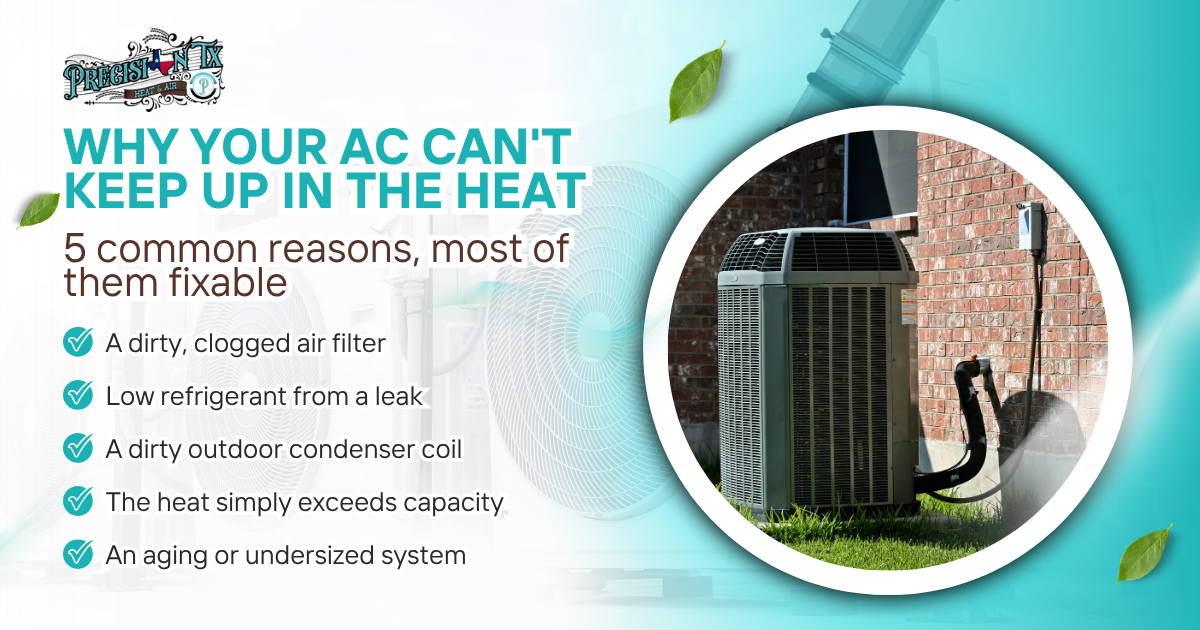
Precision TX Heat and Air is a family-owned HVAC company based in Lavon serving Rockwall County and the surrounding DFW communities. Here are the five most common reasons an AC struggles to keep up in a heatwave, and what to do about each.
1. A Dirty Air Filter Is Choking Your Airflow
The most common reason an AC cannot keep up, and the easiest to fix, is a clogged air filter. It is also the one homeowners overlook most.
Your AC needs a steady flow of air across its coils to cool your home. When the filter clogs with dust and debris, it restricts that airflow, forcing the system to work harder while delivering less cooling. During a heatwave, when the unit is already running almost constantly, a dirty filter can be the difference between keeping up and falling behind. In severe cases, the restricted airflow makes the evaporator coil freeze up, which shuts cooling down entirely.
The impact is bigger than most people expect. The U.S. Department of Energy states that replacing a dirty, clogged filter with a clean one can lower an air conditioner's energy consumption by 5% to 15%. During peak summer use, the DOE and HVAC professionals recommend checking the filter monthly.
What a dirty filter causes:
- Restricted airflow and weaker cooling
- The system running longer and harder
- Higher energy bills during peak use
- A frozen evaporator coil in bad cases
This is the first thing to check when your AC struggles, and often the cheapest fix. If a fresh filter does not solve it, the problem is deeper.
2. Low Refrigerant From a Leak
If your AC is running but blowing air that is not truly cold, low refrigerant is a likely cause, and it points to a problem that needs a professional.
Refrigerant is the substance that actually absorbs heat from your indoor air and carries it outside. When the level is low, the system loses its ability to remove heat, so it runs and runs without ever cooling the house properly. Here is the key thing homeowners should understand: refrigerant is not consumed like fuel. It circulates in a sealed loop. If the level is low, there is a leak, and simply adding more without fixing the leak is a temporary patch that will fail again.
Signs of low refrigerant:
- Air from the vents that is not cold enough
- The system running constantly without cooling
- Ice or frost on the refrigerant lines or coil
- A hissing sound near the indoor unit
Refrigerant work requires EPA certification by law and should never be a DIY attempt. A licensed technician finds the leak, repairs it, and recharges the system to the correct level. This is also connected to the ongoing refrigerant transition, which the Precision TX article on
what the 2026 refrigerant change means for repair-versus-replace decisions covers in detail.
3. A Dirty Outdoor Condenser Coil
Half of your AC system sits outside, and when that outdoor unit cannot do its job, the whole system struggles, something that gets dramatically worse in extreme heat.
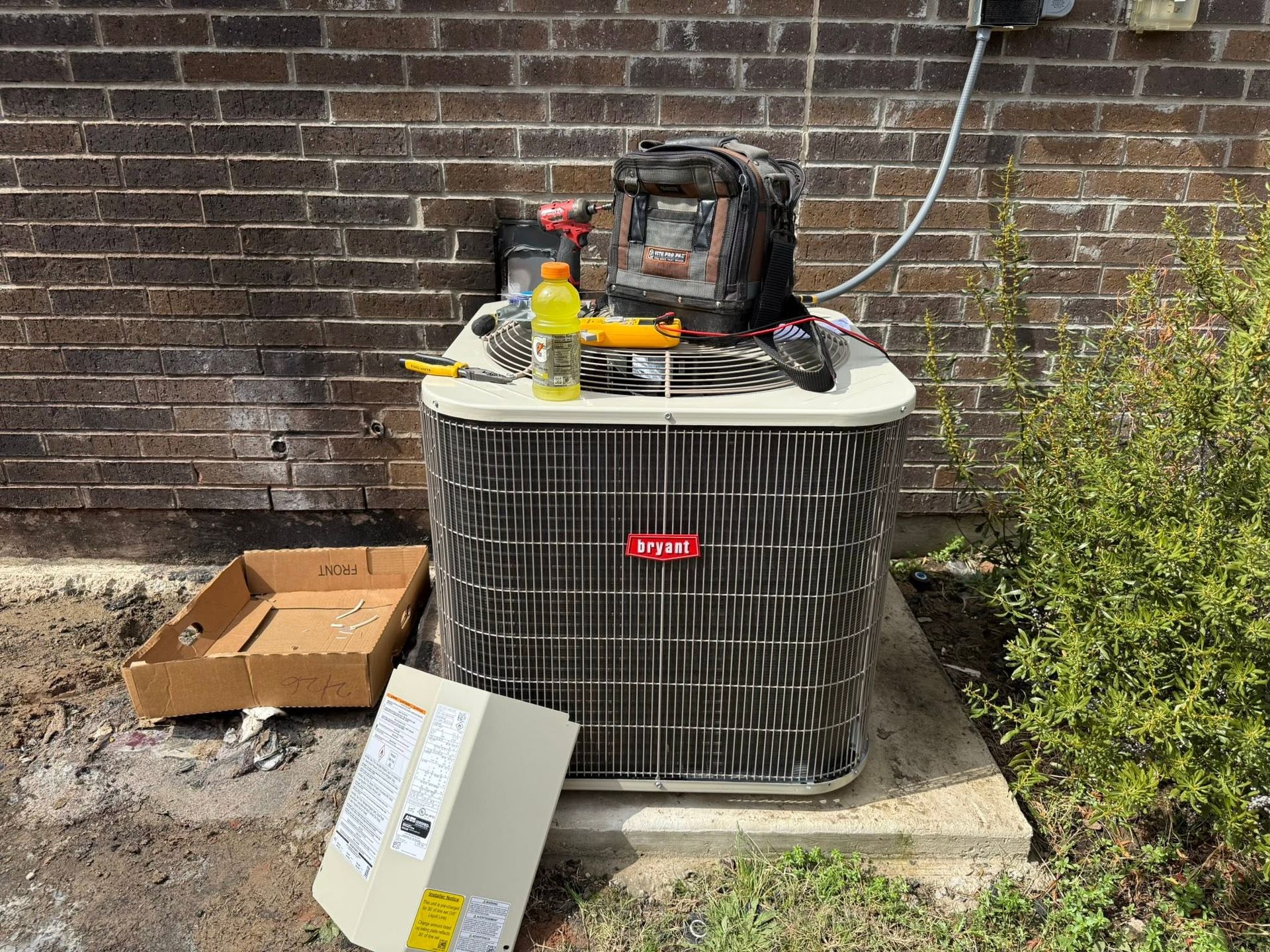
The outdoor condenser's job is to release the heat your system pulled from inside the house. It does this through coils that need clear airflow and clean surfaces. When those coils are caked with dirt, grass clippings, or debris, or when foliage crowds the unit, the system cannot release heat efficiently. During a DFW heatwave, when the outdoor air is already 100-plus degrees, the condenser is fighting to dump heat into an environment that is barely cooler than the heat it is trying to reject. A dirty coil in that situation is often the tipping point.
What hurts the outdoor unit:
- Dirt and debris caked on the condenser coils
- Grass, leaves, or foliage crowding the unit
- Less than two feet of clearance around it
- A hot, enclosed spot with poor airflow
Homeowners can help by keeping the area around the outdoor unit clear and free of debris, maintaining at least two feet of clearance on all sides. A professional coil cleaning as part of seasonal maintenance restores the unit's ability to shed heat, which is exactly what it needs most during a heatwave.
4. The Heatwave Simply Exceeds Your System's Capacity
Sometimes the struggle is not a malfunction at all. It is physics, and understanding this one saves a lot of frustration.
Air conditioners are engineered to cool a home to roughly 20 degrees below the outdoor temperature. When it is 105 degrees outside during a DFW heatwave, a properly working system may only be able to bring the indoor temperature down to around 80 to 85 degrees, no matter how long it runs. This is normal operation reaching its design limit, not a breakdown. A system that keeps the house comfortable in May but seems to fall behind in early August has not gotten worse. The demand on it has gotten far greater.
What this looks like:
- The house cools, but not to the thermostat setting
- The unit runs continuously through the hottest hours
- Cooling catches up in the evening as temps drop
- The system performs fine at more moderate temperatures
The practical response is to set realistic expectations during the worst of the heat, reduce the load on the system by closing blinds against direct sun, and avoid heat-generating activities midday. That said, if the system cannot keep up even at more moderate temperatures, the problem is not capacity, it is one of the fixable issues above, and it is worth a professional look.
5. An Aging or Undersized System
If your AC struggles year after year during summer heat, and especially if it is getting up in age, the underlying issue may be the system itself.
Air conditioners lose efficiency as they age, and the constant demand of North Texas summers accelerates that decline. A system that is more than 10 to 12 years old, has needed frequent repairs, and can no longer keep the house comfortable during a heatwave may be reaching the end of its useful life. Separately, a system that was undersized for the home, or that has to fight against inadequate attic insulation and leaky ductwork, will never keep up during extreme heat no matter how well maintained it is, because it is being asked to do more than it was built for.
Signs the system itself is the problem:
- Age past 10 to 12 years with declining performance
- A pattern of frequent, costly repairs
- Struggling every summer, not just this heatwave
- Uneven cooling that points to ductwork or sizing
This is where the repair-versus-replace conversation comes in. Not every aging system needs replacing, and a good technician will tell you honestly which situation you are in rather than defaulting to the expensive answer. Precision TX offers financing and honest assessments to help homeowners make that call with full information.
Quick Diagnosis: What Your AC Is Telling You
Matching the symptom to the likely cause helps you know whether to try a quick fix or call for service.
| What you notice | Likely cause |
|---|---|
| House warm, filter looks dirty | Clogged air filter |
| Air blowing but not cold | Low refrigerant, likely a leak |
| Outdoor unit hot, coils dirty | Dirty condenser coil |
| Cools some, but not to setpoint at 105 | Heat exceeding system capacity |
| Struggles every summer, older unit | Aging or undersized system |
If a clean filter and clear outdoor unit do not restore cooling, the cause is one that needs a professional diagnosis rather than more waiting in the heat.
What You Can Do Right Now During a Heatwave
While you decide whether to call, a few steps ease the load on a struggling system and keep your home more comfortable.
| Action | Why it helps |
|---|---|
| Replace the air filter | Restores airflow the system needs |
| Clear debris around the outdoor unit | Lets it release heat efficiently |
| Close blinds on sun-facing windows | Cuts the heat load on the home |
| Avoid oven and dryer use midday | Reduces indoor heat during peak hours |
| Set a realistic thermostat target | Prevents nonstop running at an impossible setpoint |
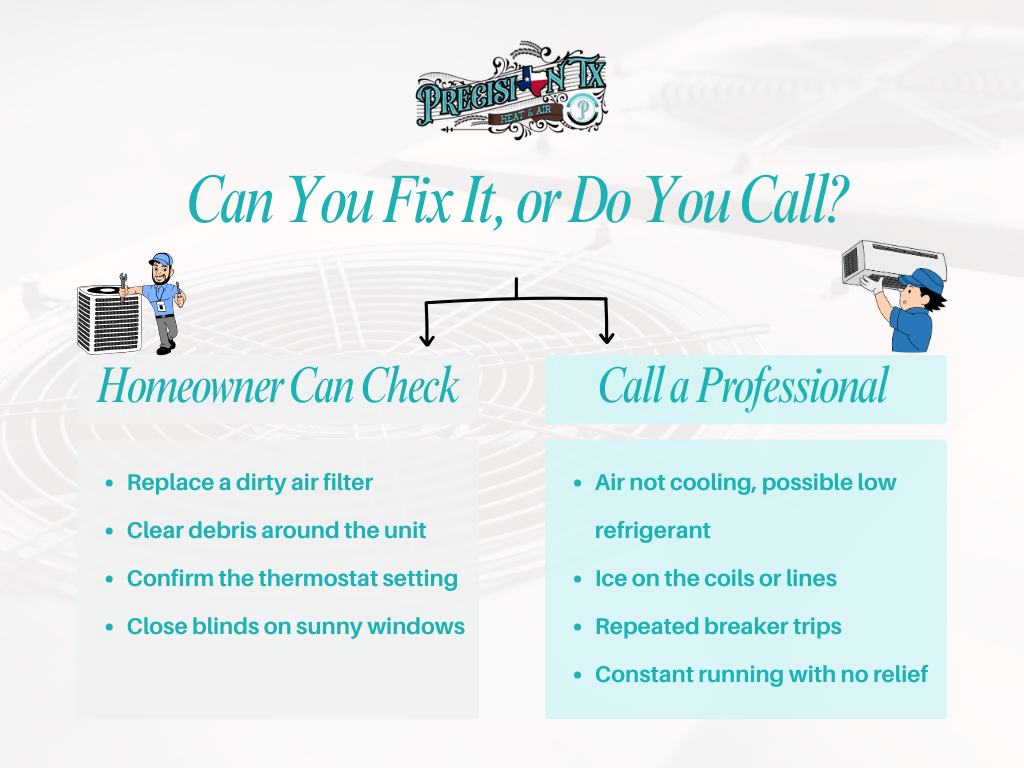
These are homeowner steps, not repairs. The Department of Energy and HVAC professionals both caution against opening equipment panels, handling wiring, or attempting refrigerant work, which is unsafe and, for refrigerant, illegal without certification.
When the simple steps are not enough, especially during a heatwave when a failed AC is a genuine health concern for older residents, young children, and pets, professional help is the right call. Precision TX provides 24/7 emergency AC repair across Lavon, Royse City, Rockwall, Fate, and Heath, and offers discounts for first responders, veterans, active-duty military, and teachers. The airconditioning page covers the full range of repair and maintenance, and scheduling an assessment gets a technician to your home.
Frequently Asked Questions
Why is my AC running constantly but not cooling during the heatwave?
There are a few common causes: a dirty air filter restricting airflow, low refrigerant from a leak, a dirty outdoor condenser coil that cannot release heat, or simply outdoor temperatures so high that the system has reached its design limit. Start by checking the filter and clearing any debris around the outdoor unit. If the air still is not cooling after that, particularly if it is not cold at the vents, it is time for a professional diagnosis.
Is it normal for my AC to not reach the thermostat setting when it is 105 outside?
Yes, to a point. Air conditioners are designed to cool a home to roughly 20 degrees below the outdoor temperature, so at 105 degrees, reaching 80 to 85 indoors can be normal operation at the system's limit rather than a malfunction. If the system cannot keep up even at more moderate temperatures, though, that points to a fixable problem like a dirty filter, low refrigerant, or a dirty coil.
How often should I change my AC filter during a North Texas summer?
During peak summer use, monthly is the general recommendation. Because the system runs so much during a heatwave, filters clog faster than they do in milder weather. The Department of Energy notes that a clean filter can lower energy use by 5% to 15% compared to a clogged one, so a fresh filter both helps cooling and reduces the bill during the hardest-working months.
Can I add refrigerant to my AC myself?
No. Handling refrigerant requires EPA certification by law, and doing it improperly is both unsafe and ineffective. More importantly, low refrigerant means there is a leak, and simply adding more without repairing the leak is a temporary fix that will fail again. A licensed technician finds and repairs the leak, then recharges the system correctly.
Should I turn my AC off during the hottest part of the day to give it a rest?
Generally no. A properly maintained system is designed to run during extreme heat, and turning it off lets the house heat up significantly, after which the system has to work even harder to recover. It is better to keep it running at a realistic setpoint, reduce the heat load by closing blinds and avoiding oven use, and let the system maintain rather than chase a lost temperature. If you are worried the constant running signals a problem, have it checked.
Does Precision TX offer emergency AC repair in Royse City, Fate, and Heath?
Yes. Precision TX Heat and Air provides 24/7 emergency AC repair across Lavon, Royse City, Rockwall, Fate, Heath, and the surrounding Rockwall County and DFW communities. The company also offers discounts for first responders, veterans, active-duty military, and teachers. During a heatwave, a home without cooling can become a real health concern, so emergency service is available when you need it.
If your AC cannot keep up during this DFW heatwave, in Lavon, Royse City, Rockwall, Fate, Heath, or anywhere in the area, Precision TX Heat and Air can diagnose why and get your home comfortable again. The team is available 24/7, offers honest assessments rather than automatic upsells, and provides discounts for first responders, veterans, military, and teachers.
Air Conditioning Services
|
Financing
|
Service Areas
|
Specials
|
Contact Precision TX
PRECISION TX HEAT & AIR
Need an HVAC Technician Today?
We are available 24 hours a day, 7 days a week. Whether it is a same-night emergency or a tune up you have been putting off, give us a call or fill out the form and we will get back to you fast.